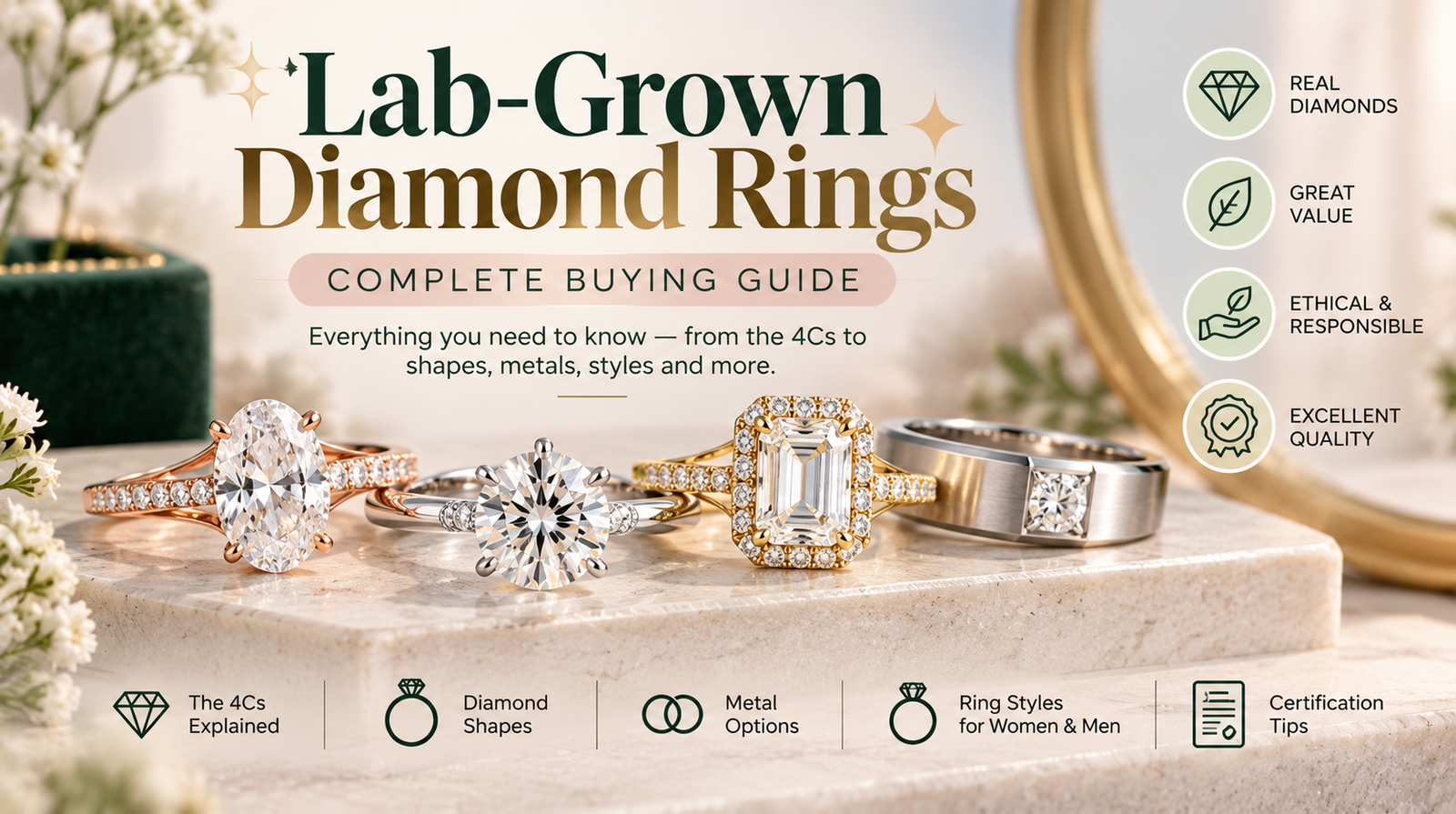
The world of jewelry has undergone a brilliant change in the past few years. The dream of owning a diamond has been strictly tied to what could be mined from the earth. However, the combination of science and style has created an amazing alternative that captures the hearts of people worldwide: lab-grown diamond rings!
If you have been thinking of buying one but don’t know where to begin, then consider this your ultimate buying guide. By the time you reach the end, you will feel confident enough to pick a ring you’ll love forever.
What is a Lab-Grown Diamond?
Let’s clear this up first.
Lab-grown diamonds are real diamonds! They have the same chemical composition, structure, sparkle, and hardness as mined diamonds. Then, the difference? Well, it lies in their origin.
Instead of forming underground for years, lab diamonds are created in labs with the help of advanced technology (high-pressure, high-temperature, or Chemical Vapor Deposition) that mimics natural conditions.
The result is a gemstone that looks exactly like a natural diamond with the same feel and features, minus the mining.
Fun fact: Since the environment wherein lab diamonds grow is controlled, they often seem to have better clarity and color consistency.
Why Are Lab Diamond Rings So Popular?
The reason why lab-grown diamonds are popular is endless; however, here are the ones as to why buyers love them the most.
1. Great Value
The cost of lab-grown diamonds is 40% to 70% less than that of natural diamonds. This means you can easily upgrade to a bigger stone. You can even opt for 1-carat lab diamond rings without stretching your budget.
2. Ethical and Conflict-Free
No mining. No ecological harm. And no concerns about sourcing. If you are someone who goes for responsible choices, then lab-grown diamonds are for you.
3. Quality Control
As they are grown under monitored conditions, several diamonds come out with excellent color and clarity. This makes them a great option for those who are seeking a flawless look.
Lab-Grown vs Natural Diamonds: The Comparison
| Category | Lab-Grown Diamonds | Natural Diamonds |
| Chemical Composition | Pure carbon (identical to natural) | Pure carbon |
| Crystal Structure | Same cubic crystal structure | Same cubic crystal structure |
| Refractive Index / Sparkle | Same brilliance, fire, and scintillation | Same brilliance, fire, and scintillation |
| Durability | 10 on the Mohs hardness scale | 10 on the Mohs hardness scale |
| Appearance | Visually identical; may have slight growth patterns | Visually identical; may have natural inclusions |
| Origin | Created in controlled lab environments using CVD/HPHT | Formed naturally over billions of years in the Earth’s mantle |
| Price | 40–70% more affordable | Significantly more expensive |
| Environmental Impact | Low; no mining involved | Higher due to excavation and mining |
| Ethical Considerations | No conflict concerns | May require additional verification for conflict-free sourcing |
| Inclusions | Often fewer inclusions due to controlled growth | Natural inclusions formed over time |
| Availability of Larger Sizes | Easier to access in bigger carats at a lower cost | Larger sizes become exponentially more expensive |
Understanding the 4Cs for Lab Diamonds
Similar to natural diamonds, lab-grown diamond rings also get graded on the 4Cs: cut, clarity, color, and carat.
Cut: Without any doubt, cut is one of the significant factors that determine how much the diamond sparkles. The lab-grown diamonds are cut using the same tools used for natural diamonds. We recommend looking for an “Ideal” or “Excellent” cut grade to get a ring that has maximum brilliance.
Color: Lab diamonds are graded on a scale from D to Z; D being colorless and Z being light yellow. Since these are created in a controlled setting, it is much easier to find high-quality colorless gemstone rings at a better price than mined diamonds.
Clarity: This is known to be the absence of blemishes or inclusions. While lab diamonds can still have minor inclusions like black spots from the carbon process. It is generally more affordable to find “Eye Clean” stones in the VS (Very Slightly Included) or VVS (Very, Very Slightly Included) range when buying lab-grown.
Carat: This is the best part! The price difference of 1 carat of lab diamond rings for women is popular. You can easily upgrade to a 2 or 3-carat ring for the same price you would pay for a much smaller natural diamond.
Choosing the Right Lab Diamond Rings
1. Pick a Shape That Matches Personality
Each shape has a distinct vibe.
For Women:
- Round: Timeless and classic
- Oval: Trendy, elongating and elegant
- Pear: Feminine and unique
- Princess: Sharp and modern
- Emerald: Vintage and sophisticated
For Men:
- Round: Clean and minimal
- Emerald: Architectural and bold
- Asscher: Geometric and refined
Tip: For a slimmer, elongated look, choose oval or emerald cuts.
2. Choose Your Metal
Your metal sets the tone of the entire piece.
- Yellow Gold: Warm, traditional, and looks stunning with classic designs
- White Gold: Sleek, modern and bright
- Rose Gold: Romantic and soft
- Platinum: Durable, hypoallergenic, and premium
For men, brushed, matte, and two-tone metals are especially popular for everyday rings.
3. Decide on the Ring Style
For women:
- Solitaires
- Halos
- Three-stone rings
- Hidden halos
- Split-shank designs
For men:
- Diamond-accent bands
- Bezel-set stones
- Modern matte finishes
- Geometric edges
4. Consider Lifestyle
If the wearer is hands-on, active, or travels frequently, then-
- Choose diamonds that are low-set.
- Use bezel or semi-bezel settings.
- Select platinum or strong gold.
- Avoid very delicate designs for everyday wear.
5. Certification
Remember to buy rings that are certified by reputable labs such as IGI or GIA. A certificate provides transparency for your diamond’s quality.
Conclusion
Picking a lab diamond ring is a smart choice. It is kind to the Earth, saves money, and looks beautiful. If you need a 1-carat ring or a nice band, lab-grown diamonds shine brightly and last a long time.
Explore more articles on our blog for helpful insights, practical tips, and ideas across different topics.
Discover my debut novel, In the Still of You, a story exploring love, healing, grief, and the courage to begin again. Visit gursheenkaur.in to learn more about my book.